Founders Q&A: How we built an AI platform you can trust for high-stakes energy infrastructure M&A
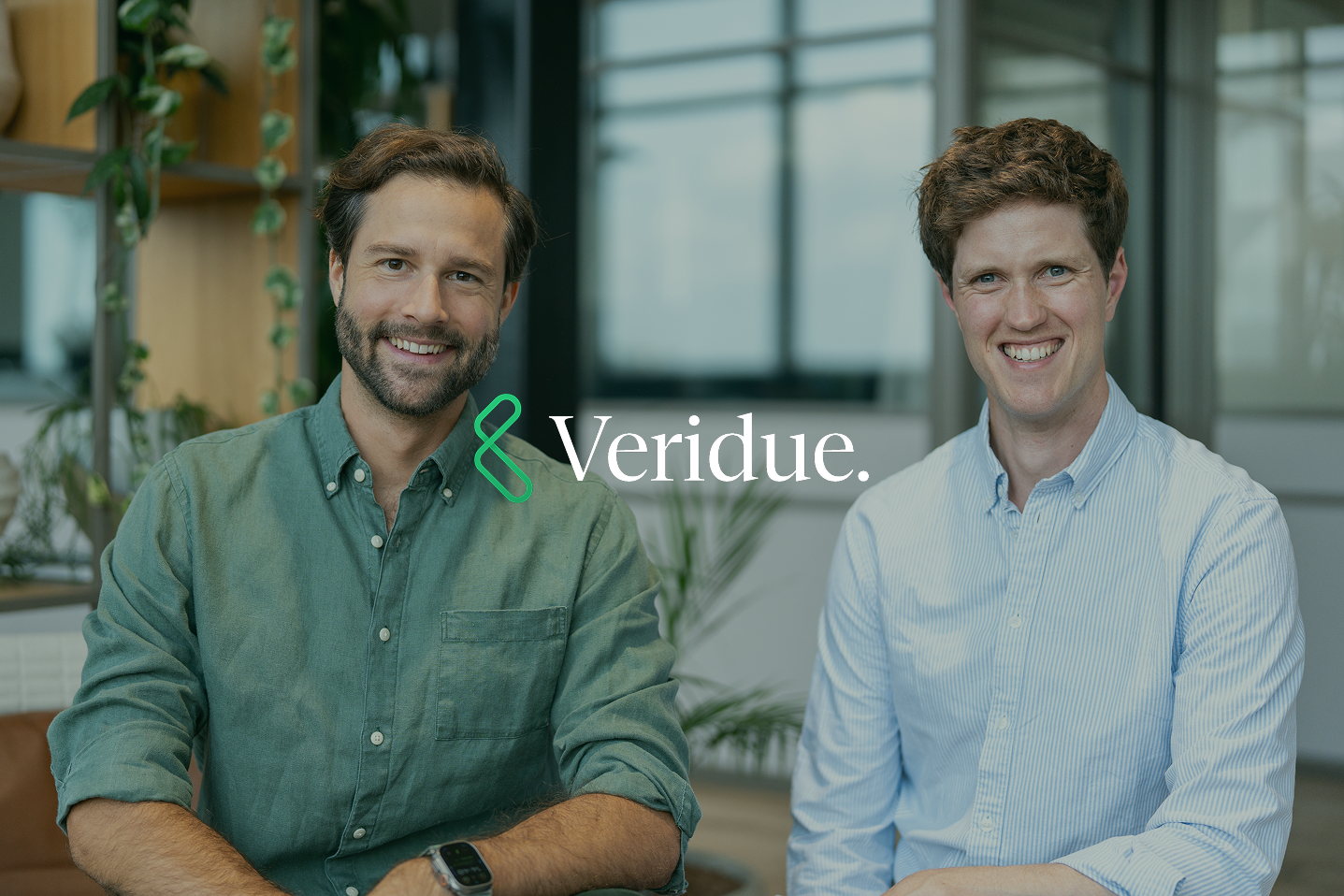
Veridue founders Daniel Csonth and Xander van den Eelaart discuss how their platform enables energy infrastructure dealmakers to confidently deploy more capital into higher quality assets.
Why did you start Veridue?
Daniel Csonth: I’ve been in the energy transition space for a decade now, on the transactions side and primarily focused on energy infrastructure. I have done over $10 billion worth of energy M&A due diligence on the advisory side with McKinsey for six years, both in their London and New York headquarters. I’ve also worked in private equity on teams investing in solar and heat pump platforms.
So, I've seen the bottlenecks in this process from multiple different perspectives.
The biggest bottleneck to energy infrastructure build-out used to be the cost of the equipment and the construction timelines. But, in recent years, the main hurdle has become the time it takes to get all the paperwork in place to get projects moving. On average it takes five years to get ready to begin a construction project that only takes one year to build.
Meanwhile, Xander is something of a unicorn in that, a year ago, very few people could claim to have worked on agentic AI in a high-stakes environment such as insurance underwriting at a top reinsurer. Xander brought in years of agentic AI and LLM experience which, at the time, only a handful of people had.
He also has vast experience in the energy space, having worked at Shell and on the insurance of over a trillion dollars’ worth of energy assets. All of that is an extremely rare combination in a CTO.
How did you go about building the platform and what were the key principles behind it?
Daniel: Two of our key principles were to create a single source of truth for energy infrastructure due diligence and to develop a platform that was integrated across the deal life cycle.
We also wanted to go deep on a single vertical – energy infrastructure – because that is the only way to add substantial value for our customers beyond what generic AI (like Claude) and ‘horizontal’ software can do.
Data security and privacy were also fundamental, while at the same time we wanted to stay at the absolute cutting edge of AI. Whenever a new AI model is launched, we test how well suited it is to our end goal, and assess its specific strengths. Given we break down due diligence into its many small component parts, we benchmark which model is best at which component part and then use that model for that task.
That means we don’t just bring the latest models to our customers, we actually create an even better AI for energy due diligence by combining the best of each model.
Trust is a key principle as well, which means we also combine the best of AI with the best of human expertise. We have a 24-hour turnaround time for due diligence, because we have very seasoned energy transaction professionals in house who review the output before it goes to customers. That additional layer of expertise enhances our credibility.
Xander van den Eelaart: Another core principle was putting the user in control and augmenting their role. For investors, we wanted to give them the information they need to take the next decision.
Rather than automating their job, our goal is ensuring they can work with all the information and insight they need. Ultimately, that means helping them stay in control of the deal.
From a technical perspective, we’ve brought our in-depth expertise in the energy sector into the product, as well as our expertise in how to manage and orchestrate a team of AI agents – thereby leveraging the continuous improvements in AI that are happening at an exponential pace.
Daniel: We are supercharging our customers’ ability to do deals, which gives them a massive competitive advantage. They can find better assets, and also win more of them because they can close deals faster, move with greater conviction and submit better bids.
Beyond simply tweaking a process that has been in place for decades, there is also an opportunity here for a fundamental rethink; a seismic shift in the way infrastructure is developed and financed in the age of AI.
Central to this is the notion of driving more clarity in the process. Often investors are only given access to a data room at a late stage of a sale or financing, because it takes a long time and lots of effort on both sides to create the data room in the first place, and then pull the information together in a format that’s ready to review.
This results in issues uncovered late on in the due diligence timeline and introduces a lot of friction, wasted costs and time.
With Veridue, the data room creates itself for the seller. The investors – who wouldn’t have wanted to pay for a detailed due diligence until later in the process – can get those insights at a fraction of the cost, so that clarity can come on day one.
So, while we integrate seamlessly into current workflows, there is a bigger opportunity there to re-shape the entire dealmaking process. In doing so we can hopefully create a much more transparent market for energy infrastructure assets and therefore massively accelerate their development and financing.
What specific mechanisms are used to prevent hallucinations or unsupported conclusions?
Xander: Every conclusion and every claim in Veridue is traced back to the original source. In practice that means for each conclusion or claim, such as every risk identified, we analyse the entire data room, which is an enormous task.
Imagine the compute when you've got multiple gigabytes in a data room, hundreds of files with thousands or tens of thousands of pages.
In contrast, other AI platforms may not necessarily look at every document or undertake a fully comprehensive search.
That’s a problem, because a single document is not where the risk lies, but also no document can be skipped over. It's often in the combination of factors and information – not just the documents in the data room, but external information too, whether that's laws or regulations, for example – that risks emerge.
This is where we differ greatly from, say, just a chatbot on top of a data room or an enterprise Claude subscription.
Crucially, when information is missing, incomplete and contradictory, Veridue doesn’t hallucinate – it's always highlighted very explicitly – because this is exactly where the risks surface during due diligence.
How does Veridue reduce the cost of doing deals?
Daniel: We essentially provide a screening and due diligence of the deal.
Typically, there’s deal origination followed by a screening process to determine which opportunities are worth pursuing. In a company with structured investment committees, you may then go to the IC and ask for a red-flag diligence budget that could run to tens of thousands, or perhaps $100,000.
You then bring in the advisors and spend weeks or months, before finding out the deal is not good or the seller is progressing with someone else – meaning all that time and money was wasted. This is what happens with 50-80% of deals.
Many players are trying to reduce at-risk fees, or not hire external advisors until exclusivity, but they are limited in their in-house capacity to do due diligence, especially with such high deal volumes.
Veridue enables our customers to push the need for external advisers – which can be 10 times more expensive – further down the process, until they have much greater confidence that they want to close the deal, while getting to that same level of diligence rigor with Veridue. Typically, we reduce fees at risk by up to 90%.
We also accelerate the deal timeline so customers can move faster than the competition. That means they can make decisions and submit bids with a higher level of conviction – or better still, take deals off-market. Sellers like buyers who have high conviction on a deal and can get them to cash faster.
We’re not yet trying to replace the confirmatory due diligence. We’re saying you can push that stage out because we can provide you all the due diligence you need to make a high conviction decision at a fraction of the cost and time.
So, why do you still need a due diligence provider at the end? We actually think our output is at least as good as a “traditional” process. It’s simply because, at the moment, some ICs and banks require a “bankable provider” to deliver that final diligence. We are building towards being regarded – and insured – as bankable too.
What else gives Veridue the edge over its competitors?
Daniel: Unlike many of our competitors, we have decades of first-hand experience in the energy industry.
We worked with customers for two years to design Veridue. I’m a former renewable energy investor and transaction advisor with over $10 billion in energy M&A experience across Europe, the US, and Asia, while Xander previously led agentic AI development for contract review and underwriting of global energy assets at a major reinsurance group in Switzerland.
That combination of deep sector and AI expertise is central to how we’ve built the platform.
We've also built a proprietary data set that we were contractually permitted to use for model training purposes so we don’t train AI on our customer’s data. As the best funded player in this space, with a purpose aligned mission, we also have the best talent in our team. On top of that we have angel investors and senior industry advisors, who are some of the most experienced and reputable folks in the industry.
Xander: We encode all of our domain knowledge – such as thousands of risk factors – into a deterministic AI layer we built ourselves.
We also orchestrate the large language models and the agents in such a way that we get reliable, accurate and auditable high-quality outputs. We know exactly what to look for and, equally importantly, we know how to get the AI to look for it – this is the secret.
Why wouldn’t a customer build an energy infrastructure due diligence AI platform in-house?
Daniel: That’s actually a big misconception nowadays; because prototypes can be built so quickly, companies just think they can do it themselves.
There are a number of flaws in that thinking:
One: Building a prototype that looks like what we are doing might be achievable in a couple of months, but there is a reason it took some of the best AI engineers – plus industry experts – years of 12 hour days and weekends to build Veridue. It is unlikely that a central software engineering team could dedicate themselves more than full time to a project like this for over a year, never mind getting the time for input from the investors and advisors they would need to build in the expertise.
Two: Building the initial product is only part of the challenge. Given how quickly the regulatory landscape, energy markets and technology change, plus how fast AI evolves, the same size of team that built it will have to perpetually maintain the software. Most don’t have the in-house capacity to do that. There is a reason this is the full-time job of an entire company – ours.
Three: While it is true that in-house engineering teams have become 10x more productive with AI coding agents, so have our engineers. The delta between buying software from a company that is dedicated to this specific area vs. an in-house team hasn’t changed.
Four: I would argue that our engineers are still 2-3x more productive than an in-house team, because we run an AI-native organisation and tooling from the foundations.
Five: There’s the question of ‘horizontal’ versus ‘vertical’. Our view is that a horizontal workflow enhancement is both much easier to build in-house and more likely to be made obsolete by off-the-shelf AI like Claude. A vertical platform like Veridue requires real domain expertise that you wouldn't have in house – for example, legal and technical due diligence capabilities – so it isn’t a good candidate for building yourself.
Six: Ask yourself whether the tool is for internal collaboration only or also for external collaboration?
It might make sense to build something in house if you're automating a huge process where multiple people within your company need to collaborate. But on a deal, you've got so many external parties – the buyer, the seller, and their respective advisers, the technical, legal, and commercial advisers etc. With all of these external parties working together, trying to bring everybody onto a platform you’ve built in house simply isn’t going to work. Can you imagine if everyone tried to force their platform onto the others? It's better to converge around a few well-known and familiar platforms.
At the moment we live in a world where AI use is super siloed to the individual. Everyone is just in their own personal chats. We bring AI into a shared workspace – it’s a whole different way of using it.
Seven: Where it’s important to have access to external data sources – for example, government databases on title and land rights, the latest regulations and rules, technology comparisons and degradation curves, benchmarks and energy price forecasts – it doesn’t make sense for that to be built in-house because you’re going to have to maintain access to all those external data sources all the time.
Eight: There are also significant network effects of multiple parties using the same platform.
And finally, I firmly believe that in 6 months from now, having AI for due diligence will be table stakes – everyone will have it. So if you use Veridue now, you can get alpha and be ahead of the competition, but by the time you will have built something like this yourself in a year, that window will have closed and you’re just using it to prevent the downside of not having it, when everyone else is using AI for their deals already.
How would you summarise what Veridue brings to deal teams?
Daniel: Using Veridue means customers can deploy more capital, into higher quality assets, and therefore generate higher returns.
This is made possible because they can screen 100 times more deals and find the best ones. They also get a full due diligence in hand on day 1, which means they can be sharper and move with greater conviction than the competition and avoid wasting time – precious opportunity cost – and advisor fees on deals where red flags would have otherwise surfaced.
Speed and rigour used to be at odds with each other. With Veridue the entire industry gets to move faster and with greater rigour at the same time. Just like it says on the tin: Veri fast. Veri diligent. Veridue.

.png)